Miami-Dade County regulations prohibit independent general contractors and retail operators from setting commercial renovation debris out for residential bulk trash routes, which run on rigid bi-weekly cycles and…
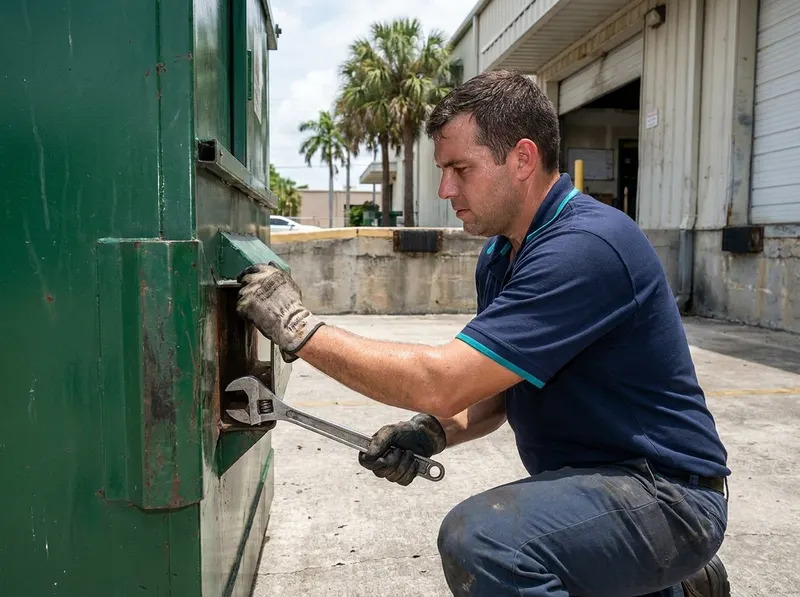
Miami-Dade County regulations prohibit independent general contractors and retail operators from setting commercial renovation debris out for residential bulk trash routes, which run on rigid bi-weekly cycles and reject commercial construction refuse entirely. When an interior strip-out in the Design District or an active warehouse reorganization in Allapattah generates tons of broken display cases, dimensional lumber, and corrugated boxes, commercial solid waste collection provides on-demand roll-off containment directly on site. Commercial waste collection differs from municipal franchise cart services: franchise haulers handle routine municipal wheelie bins on long-term contracts, whereas roll-off solid waste service manages episodic, high-volume bulk surges that overwhelm permanent compactors or standard dumpster corrals. Selecting a 20-yard roll-off container accommodates roughly 6 to 8 standard pickup truck loads of retail fixtures, balancing payload volume against tight access lanes behind Brickell storefronts, whereas a larger 30-yard or 40-yard container handles light, high-bulk distribution waste along industrial corridors near Coral Way and Wynwood at the cost of requiring 60 feet of linear approach clearance for the roll-off truck rails.
Navigating Miami job sites requires proactive property protection to prevent expensive surface damage. Commercial roll-off trucks exert substantial hydraulic point-pressure during delivery and retrieval, which fractures decorative concrete in Coconut Grove commercial alleys, asphalt staging pads in Edgewater, and older brick paver aprons along Little Havana access lanes. Direct local drivers place clean structural timber blocking beneath all steel rollers before dropping the bin, isolating the container weight from the client's paved deck. This protects the pavement, eliminates scrape gouges, and avoids property maintenance chargebacks. A direct line to local dispatchers at (239) 523-9721 prevents the communication bottlenecks common with national waste brokers who subcontract loads to unknown haulers. Calling directly means adjustments for street parking constraints, tight turnaround clearances near LoanDepot Park, or extended collection intervals during multi-phase builds are managed in real time.
To coordinate commercial waste removal without disruptions or municipal citation risk, teams follow a three-step sequence: Step 1 involves contacting local dispatch at (239) 523-9721 to declare the waste profile, target tonnage, and designated ground drop location. Step 2 requires setting three-quarter-inch hardwood planks or high-density composite pads across the delivery path prior to truck arrival, ensuring heavy steel wheels never contact bare brick, stamped concrete, or thin parking lot sealcoats. Step 3 is loading the bin level with the top rim, avoiding side-wall build-ups that violate Florida Department of Transportation road safety standards, followed by requesting a pick-up haul with final disposal directed exclusively to licensed Miami-Dade County resource recovery facilities.
Every job gets a firm, written price after a free on-site visit.
Tell us about your commercial solid waste collection job in miami and we'll send a clear, written quote, usually the same day.
 Coastal Dumpster Rental